
The lack of first aiders or paramedics once again came under scrutiny when two players collided, knocking heads and needed serious medical attention – with not a single medical officer in sight at the final round of the Engen KO Challenge at the Chukker Road Sports Complex on Sunday.
If it wasn’t for the assistance of the club’s medical staff, things could have turned nasty.
When the Safa officials on duty were informed about the incident, they were rather surprised as they weren’t aware of it. However, they too acknowledged that there is a need for (medical) safety at football matches.
This has been an aspect of the game which has been severely neglected in the past and up until today.
Just recently the region mandated FN Rangers to have medical personnel present when they hosted their first youth tournament otherwise they would not sanction the event – which the Maitland-based obliged with.
Our website can also confirm that there was no medical presence during our visit to the complex at the Johnston Road Sports field where the other Engen matches took place on Sunday.
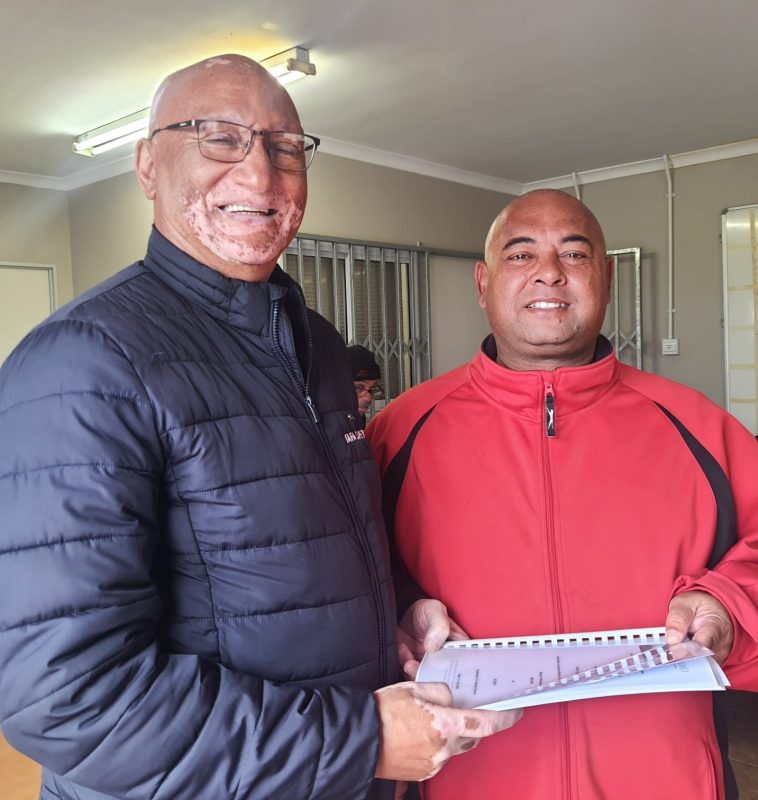
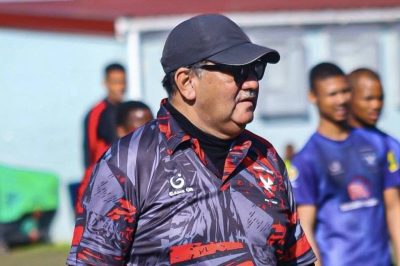
Rashied Isaacs (pictured right), a researcher who did a thesis on safety at football fields has been advocating safety on football fields in the amateur ranks for years.
Isaacs handed over the findings and recommendations of his thesis to the president of Safa Cape Town, Bennett Bailey, in August last year.
During his research it was discovered that 15 deaths were recorded between 2007 and 2023 including a match official. The youngest fatality was a 16-year-old player from Mitchells Plain while the oldest was a 66-year-old male from Athlone.
“Thirteen people died of suspected heart attacks and one of a head injury and another one of a blow to the chest,” Isaacs told No Bones with Jones.” The presence of the first responders is of paramount importance and should not be underestimated or taken for granted.
“Look, I cannot say that CPR (cardiopulmonary resuscitation) would have saved the lives of those who collapsed on the field, but what it does is it will give you a fighting chance and this is what I noted in my thesis,” Isaacs added.
Meanwhile, Safa Cape Town president Bennett Bailey responded by saying that they will take this one “on the chin.”
“Perhaps we took it for granted that these (safety) measures would have been implemented by the host club as it should be a shared responsibility as well,” Bailey said to our website. “That is why they collect money at the gate as we don’t collect the gate fees. But we are happy that people raise these issues as it shows a certain level of awareness.
“For the record, we also never kicked Rashied’s thesis out. No, we learnt from it and it is part of the process of how we learn. But we shouldn’t be the only people that learn from it, everybody should learn and benefit from it,” Bailey concluded.


One Response
With reference to “SAFA takes Engen-lapse as knock on the chin”, the response reminds me of political nonsense. Injuries at school level, concussion protocols, the way rugby schools are meticulous in their preparation, etc. to assist medical personnel should injuries occur, are widely reported. Hindsight is really an exact science as “after the fact” statements are becoming a hallmark of SAFA. Sport always involve the well-being of the participants, so appoint conscientious, willing individuals who genuinely want to ensure that logistical operations are in place. How many times have learners/children not lose their lives or become paralyzed on the sports field? That tells me properly trained personnel is of the essence. With proper medical treatment, many sportspeople can prolong their sport careers. The powers-that-be must look seriously at their own functions. They must remember :”Promises are like babies, easy to conceive but difficult to deliver”. It’s about service delivery. I do understand funding, availability of qualified personnel, etc. can hamper the effectiveness of operations. So, I don’t expect perfection, far from it, however, we are dealing with the well-being of individuals.